

PH pushes coordinated action vs. plastic, garbage problem
By Marita Moaje
MANILA – The Philippines is working to bring together government programs, private-sector efforts and development assistance to address the worsening plastic and garbage problem, with a national plastics roadmap being prepared to identify gaps and guide investments.
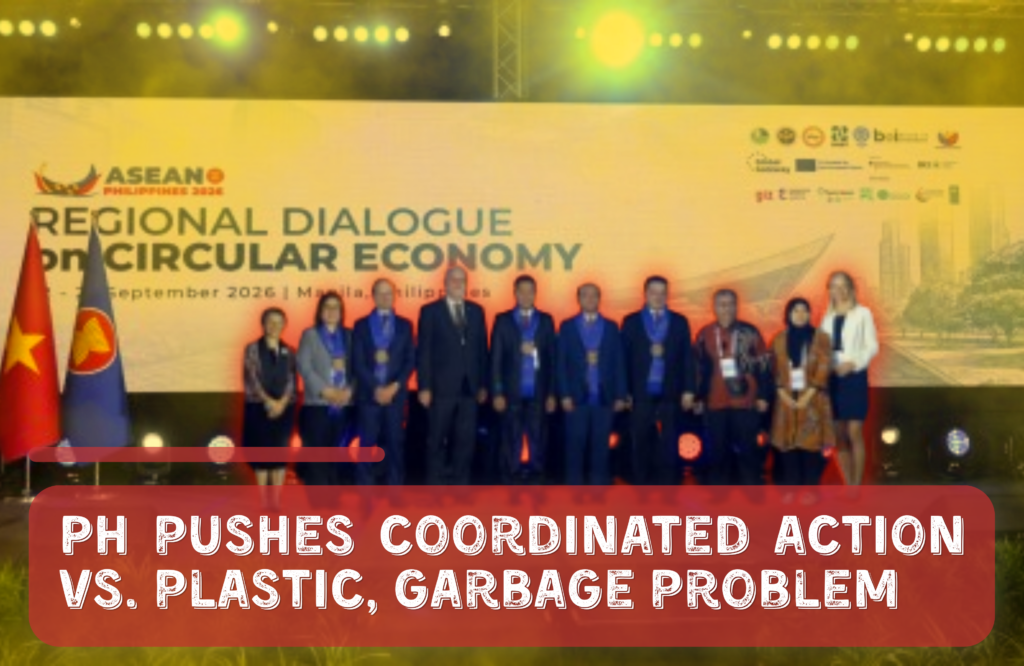
At the ASEAN Regional Dialogue for Circular Economy in Makati City on Tuesday, Department of Environment and Natural Resources Undersecretary Jonas Leones said government agencies, local governments and development partners are already implementing programs to address plastic waste, but noted that the efforts need to be mapped to identify gaps.
“So, through this conference, we will be identifying what’s there, what are the partners doing, and hopefully we can identify gaps and possible investments to make sure that we are on the same page and we are not duplicating the incentives of those development partners. So through this program, we can sit down and discuss what needs to be done to address this plastic problem and garbage problem,” Leones said.
“That’s the reason why we invited the development partners, the donors, so that they can see where they can be involved in implementing activities that are not being done, so that we can ensure that our actions are synchronized and we can achieve our purpose in addressing this problem,” he added.
Leones cited the over 200 truckloads of garbage washed in by high tides and heavy rains due to the southwest monsoon, or “habagat,” in the Redemptorist Water Channel in Parañaque City.
“I cannot really say when we can finish addressing this, but what we can assure is that we will be putting appropriate policies to address our garbage problem. We will be identifying technologies, appropriate technologies, in addition to what we have right now, so that we can ensure that we can achieve addressing this problem,” he said.
“This roadmap will serve as a blueprint on how the Philippines can address the garbage problem,” he said.
He stressed the importance of financing in implementing the roadmap, as development partners can support activities that remain unfunded or have yet to be developed.
Leones said the government is also looking at technologies and successful waste-management practices from other countries and local governments that could be adapted to Philippine conditions.
“We do not want to invent knowledge. What we need to do is just to look elsewhere, to look at good models and success stories in handling waste,” he said.
He said there is no fixed timetable for solving the garbage problem because the government still has to identify appropriate policies and technologies.
Marco Gemmer, Head of Cooperation of the European Union Delegation to the Philippines, noted that the EU is also looking at how European businesses can help meet local governments’ investment and technology needs.
“We will take the investment needs to the European Chamber of Commerce in the Philippines, to the business chambers of our EU member states, to identify potential European companies that could come with the technology and potentially be the investment,” Gemmer said.
He said the shift to a circular economy requires continuing efforts rather than a one-time solution.
Alternatives needed for single-use plastics
Leones said the government supports efforts to reduce single-use plastics, but affordable and functional alternatives must be available first.
“We can only be successful in banning single-use plastics if we already find an alternative to single-use plastics that has the same affordability and functionality,” he said.
He noted that some communities, particularly in remote areas, still depend on single-use plastics, making enforcement difficult without readily available alternatives.
Improving EPR implementation
DENR Environmental Management Bureau (EMB) Director Michael Drake Matias said the government is also working to strengthen implementation of the Extended Producer Responsibility (EPR) program, which requires covered companies to recover plastic packaging waste.
To date, he said about 1,059 entities are registered with the EMB, including more than 200 obliged enterprises, while smaller businesses may participate voluntarily.
Matias said compliance with recovery targets does not necessarily show the full amount of plastic remaining unmanaged in communities but noted that the DENR is working with producer responsibility organizations, recyclers, local governments, companies and civil society to improve information and recovery efforts.
Circular economy beyond waste
In his video message, DENR Secretary Juan Miguel Cuna said the shift to a circular economy requires changing how resources are sourced, products are designed and used, and materials are kept in circulation.
“As we shift to a circular economy, we have to widen our perspective. We must consider the full life of a product and the value of the materials that go into it: how resources are sourced, how products are designed and used, how long they remain useful, and how value can be retained instead of being lost after a single use,” he said,
Cuna noted that a circular economy can reduce pressure on natural resources, strengthen resilience to supply disruptions, improve resource productivity, encourage innovation and investment, and create new opportunities for enterprises and workers.
He also said a circular economy can make cities and communities cleaner, healthier, and more livable.
Cuna said keeping materials in use longer can reduce pressure on natural resources, strengthen resilience to supply disruptions, and create opportunities for innovation, investment, and jobs.
“Government cannot deliver this transformation alone. Circular is a shared responsibility,” he said, noting the need for an ecosystem that supports policies, markets, financing, innovation, institutions and changes in behavior.
The two-day ASEAN Regional Dialogue on Circular Economy started in Makati City under the Philippines’ 2026 ASEAN chairship. (PNA)